Effective project planning is the foundation for achieving your business objectives. By setting clear milestones and creating a well-defined roadmap, you ensure your team stays focused and aligned. This section is all about guiding your projects from idea to execution with strategic foresight.
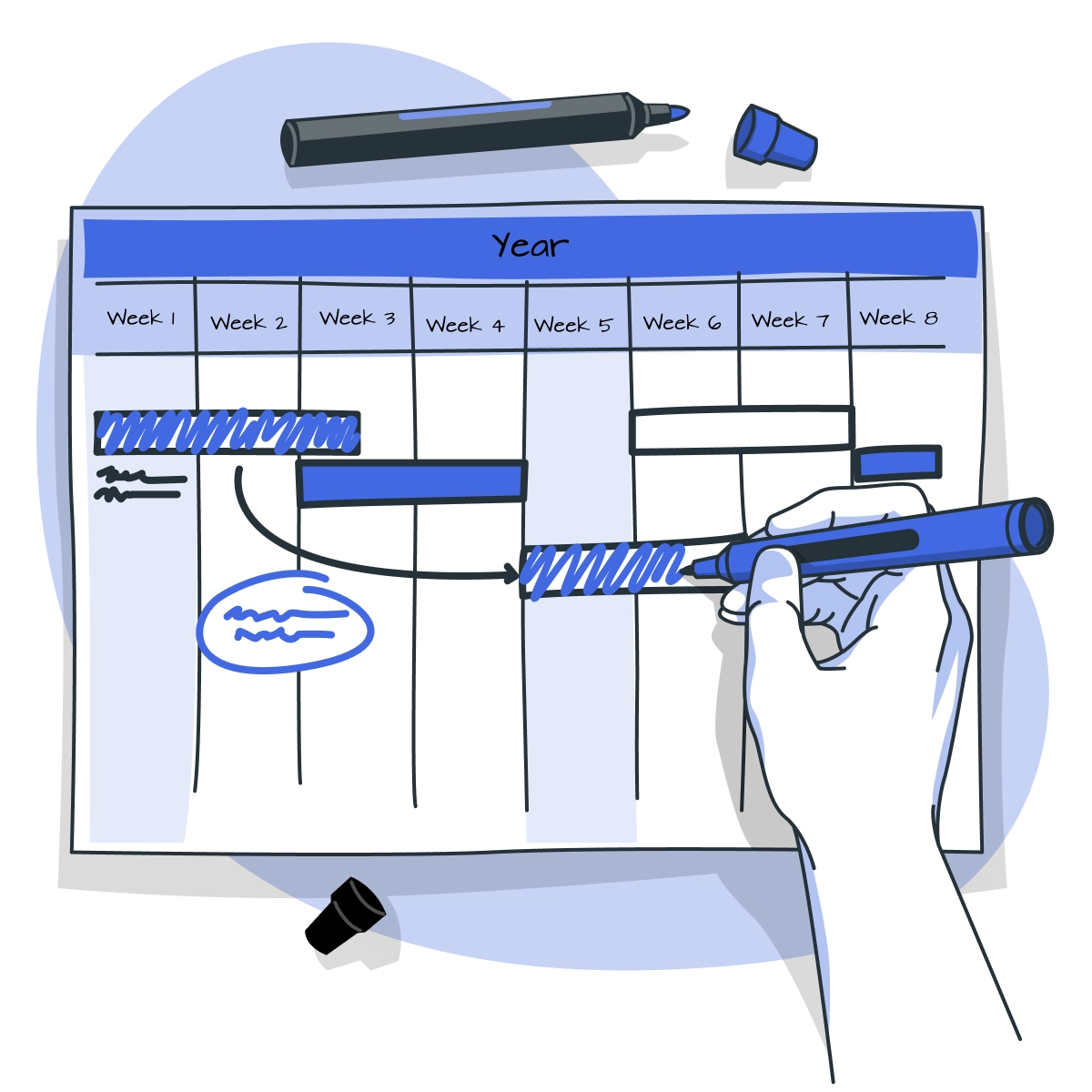
A well-defined roadmap is the difference between successful projects and costly delays
Define explicit objectives, deliverables, and success criteria that align your entire team around shared goals.
Develop achievable schedules with buffer time for risk, ensuring projects stay on track and stakeholder expectations are met.
Optimize team allocation, budget distribution, and skill requirements to maximize efficiency and minimize waste.
Identify potential blockers early and develop contingency plans, reducing the impact of unforeseen obstacles.
Organizations with comprehensive project plans consistently deliver better results
reduction in schedule overruns
through improved resource planning
with clear milestones and tracking
reduced scope creep and changes
Establish Clear Strategic Direction
We work with stakeholders to crystallize your project vision into measurable objectives. This foundational step ensures alignment and provides the basis for all downstream planning activities.
Define What Will Be Delivered
Comprehensive requirements gathering ensures nothing is missed and prevents expensive scope creep. We document functional and non-functional requirements, constraints, and assumptions.
Allocate Resources and Define Timeline
Realistic resource allocation and scheduling are critical for project success. We estimate effort, identify resource requirements, and develop detailed timelines with contingency buffers.
Identify and Plan for Uncertainties
Proactive risk management prevents surprises and enables quick response to issues. We identify potential risks, assess their impact, and develop mitigation strategies.
Manage Expectations and Keep Everyone Informed
Clear communication prevents misalignment and manages expectations. We develop communication plans that keep stakeholders informed without overwhelming them.
Create Flexible, Evolving Plans
Modern projects require flexibility. We develop roadmaps that provide clear direction while allowing for adaptation as conditions change and new information emerges.
We select and adapt frameworks based on your project type and organizational context
Traditional sequential planning for projects with well-defined requirements and minimal changes. Ideal for regulated industries and fixed-scope projects.
Flexible, iterative planning that embraces change. Perfect for innovative products and rapidly evolving markets where requirements emerge over time.
Combines waterfall structure with agile flexibility. Plans are developed with phases, but with built-in adaptation points and iterative refinement.
Stage-gate approach with decision points between phases. Provides control and clarity while allowing for plan adjustments at defined gates.
Objectives and Key Results provide strategic alignment. Planning focuses on ambitious goals with measurable outcomes and quarterly adjustments.
Detailed planning near-term, high-level for distant future. Allows refinement as you learn more, reducing unnecessary guessing for distant milestones.
We deliver comprehensive documentation that guides execution and manages stakeholder expectations
Formal authorization document defining project objectives, high-level requirements, success criteria, and stakeholder roles.
Hierarchical decomposition of project scope into manageable components, defining all work to be performed.
Gantt charts and critical path analysis showing activities, dependencies, durations, and milestones with realistic timelines.
Team composition, skill requirements, role definitions, staffing timeline, and capacity allocation across project phases.
Detailed cost estimates by phase and deliverable, resource costs, contingency reserves, and cash flow projections.
Comprehensive identification of risks, probability and impact assessment, mitigation strategies, and monitoring plans.
Stakeholder matrix, communication frequency and methods, status reporting templates, and escalation procedures.
Visual representation of major releases and milestones, showing timeline and key deliverables for stakeholder alignment.
Define project vision, business case, and success criteria. Identify stakeholders and establish planning team.
Conduct workshops and interviews to capture functional, technical, and non-functional requirements from all stakeholders.
Document project boundaries, create Work Breakdown Structure (WBS), and define what is in and out of scope.
Identify activities, estimate effort and durations, sequence activities, and create detailed project schedule with milestones.
Determine team composition, estimate costs, allocate resources across timeline, and develop staffing plan.
Identify potential risks, assess probability and impact, develop mitigation strategies, and create risk register.
Integrate all planning components, validate baselines, get stakeholder approval, and establish baseline for tracking.
Present roadmap to stakeholders, train team on plan execution, establish monitoring procedures, and enable adaptive updates.
Elements that separate successful projects from troubled ones
Active participation of key stakeholders in planning ensures alignment, buy-in, and realistic planning based on actual constraints.
Well-documented, understood, and agreed-upon requirements prevent misalignment and expensive rework during execution.
Accurate effort and duration estimates, validated against historical data, prevent overly optimistic timelines and schedule pressure.
Clear project boundaries with documented inclusions and exclusions prevent scope creep and manage customer expectations.
Proactive risk identification and planning enables rapid response to issues and prevents catastrophic surprises.
Plans that allow for adaptation and refinement as new information emerges prove more effective than rigid, unchangeable plans.
We help teams navigate obstacles that derail planning efforts
Solution: Employ iterative refinement with stakeholder approval gates. Use prototyping and detailed requirements workshops to crystallize needs early.
Solution: Establish baselines from historical data, use proven estimation techniques, and build in buffers. Educate stakeholders on effort drivers.
Solution: Involve stakeholders early and frequently in planning. Demonstrate how plans address their concerns and provide visibility to progress.
Solution: Distinguish between necessary planning and unnecessary detail. Use rolling wave planning to plan deeply near-term and at high-level for far future.
Solution: Prioritize ruthlessly, consider phased delivery, explore resource augmentation options, and align scope with available capacity.
Solution: Develop plans collaboratively so teams own them. Establish clear ownership, track progress visibly, and adapt regularly based on actuals.
Let our planning experts develop a comprehensive roadmap that turns your vision into actionable strategy. We ensure alignment, realistic timelines, and successful execution.