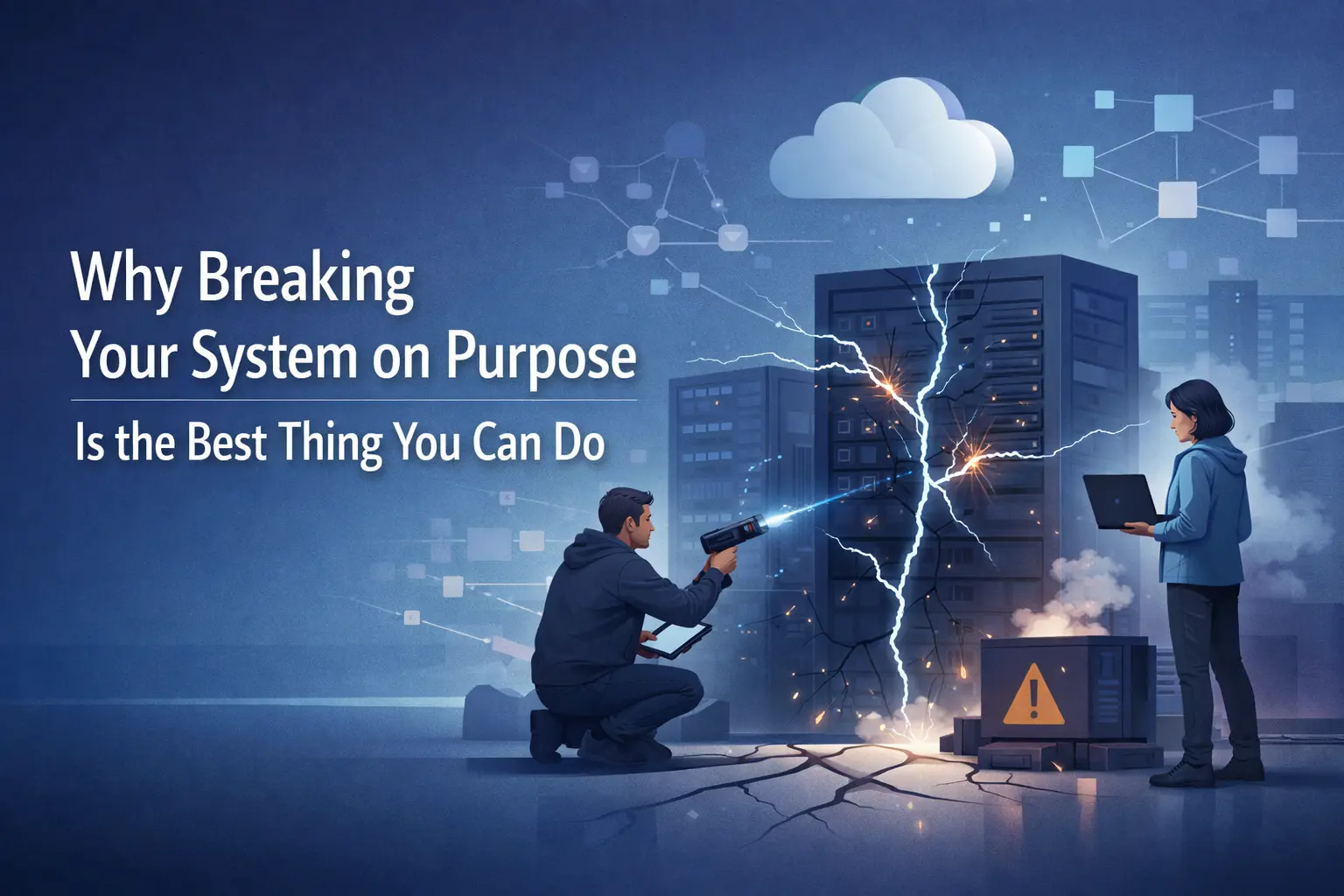
Most teams test their systems under expected conditions. Traffic looks normal. The database responds on time. Everything passes. The team ships with confidence.
Then production happens.
Real traffic is unpredictable. Users do not behave like test scripts. A product launch, a viral moment, or even a scheduled batch job can push a system far beyond what anyone planned for. Testing only at "normal load" does not tell you how your system behaves under pressure. It only tells you how it behaves when nothing is wrong.
That is not useful information.
Here is the thing about normal load: your system was built to handle it. Of course it passes those tests. Designing for average conditions is straightforward engineering. The hard part is designing for what happens when average goes out the window.
Systems do not fail under normal conditions. They fail at the edges - during traffic spikes, hardware degradation, network partitions, or slow cascading failures that started three layers deep. If your test environment never surfaces those conditions, you are not testing your system. You are confirming that it works when it does not need to try.
Pushing a system past its limits on purpose is not reckless. It is disciplined. The idea is simple: find out where the cracks are before your users do.
This means running stress tests that go well beyond expected peak traffic. It means simulating what happens when an entire region goes offline. It means forcing your database into a bottleneck and watching how the rest of the application responds. These are not edge cases you hope to avoid. They are scenarios you need to understand deeply.
The goal is not to make the system fail. The goal is to learn exactly how it fails, and what happens next.
There is a significant difference between a failure in staging and a failure in production. One costs you time. The other costs you users, trust, and sometimes revenue.
When a system fails in staging after an intentional stress test, that is a win. You now have specific, observable evidence of a weakness. The failure has a timestamp, a log, a traceable cause. You can study it, discuss it, and address it on your own timeline.
When it fails in production, you are reacting under pressure, often in the middle of the night, with real users on the other side of the outage.
Staging failures are information. Production failures are incidents.
Teams that build resilient systems think differently about failure. They do not treat a system breaking in testing as a bad sign. They treat it as the entire point of the exercise.
This mindset shift changes how you write tests, how you plan capacity, and how you evaluate readiness for production. A system that has never been pushed to failure has not truly been tested. It has only been observed doing what it already knows how to do.
The most important question to ask before any release is not "did it pass?" It is "did we actually challenge it?"
At small scale, problems are forgiving. A slow query adds a few milliseconds. A retry loop wastes a little CPU. These things are easy to ignore, and often are.
At scale, those same problems compound. A slow query that was acceptable at a hundred requests per second becomes a complete outage at ten thousand. The behavior you never tested becomes the behavior that takes your system down.
Scalability does not introduce new kinds of problems. It amplifies the ones that were already there and waiting.
Testing under normal conditions will tell you that your system works. Testing under intentional stress will tell you whether it can be trusted. Those are very different things.
The teams that build systems users rely on are not the ones who avoided failure. They are the ones who engineered for it, chased it down in staging, and refused to ship until they understood it. Failure is not the opposite of reliability. Unexamined failure is.
Break it on purpose. Learn what breaks. Do that before your users find it for you.

At Thirty11 Solutions, I help businesses transform through strategic technology implementation. Whether it's optimizing cloud costs, building scalable software, implementing DevOps practices, or developing technical talent. I deliver solutions that drive real business impact. Combining deep technical expertise with a focus on results, I partner with companies to achieve their goals efficiently.
Let's discuss how we can help you achieve similar results with our expert solutions.
Our team of experts is ready to help you implement these strategies and achieve your business goals.
Schedule a Free Consultation